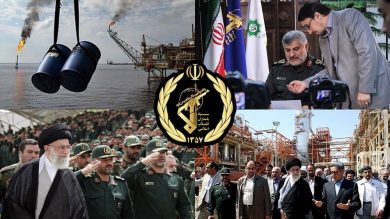
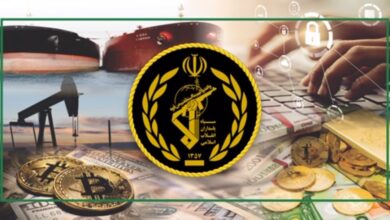
The Islamic Revolutionary Guard Corps (IRGC) is not just Iran’s elite military force—it is one of the most powerful economic empires in the Middle East. Over the past four decades, the IRGC has morphed into a sprawling conglomerate with stakes in virtually every sector of Iran’s economy: oil, construction, telecommunications, imports/exports, and even pharmaceuticals.
Its economic dominance isn’t just about wealth—it’s about control. Through shell companies, black-market smuggling, and no-bid contracts from the regime, the IRGC has hijacked Iran’s economy to fund oppression at home and terrorism abroad.
In this report, we break down the mechanics of the IRGC’s economic empire through five core infographics—offering a clear, visual narrative of corruption, profit, and state capture.
1: The Web of Control—IRGC’s Corporate Network
Overview:
The IRGC operates through hundreds of front companies, many of them under the umbrella of massive holding groups like Khatam al-Anbiya Construction Headquarters, EIKO, and Setad.
Key Facts:
• Khatam al-Anbiya alone controls over 800 affiliated companies, many winning state contracts without oversight.
• Setad (Execution of Imam Khomeini’s Order) oversees billions in seized assets, funneled into regime and IRGC ventures.
• These companies often bid against private businesses—then win via favoritism or coercion.
What It Shows:
A dense network diagram with the IRGC at the center, branching into dozens of subsidiaries operating in infrastructure, oil, tech, and finance—many under civilian-sounding names to avoid detection.
2: Who Profits—The Regime’s Economic Pyramid
Overview:
The IRGC’s economy is structured to benefit a select elite—while ordinary Iranians face poverty, inflation, and unemployment.
Three-Tiered System:
1. Top Tier:
Supreme Leader, IRGC commanders, regime insiders. Access to luxury housing, smuggled imports, and offshore accounts.
2. Middle Tier:
Basij members, loyal clerics, and regime-connected contractors. Receive state subsidies, small business monopolies.
3. Bottom Tier:
Everyday Iranians. Face 40%+ inflation, joblessness, currency collapse, and systemic corruption.
What It Shows:
A pyramid structure visualizing the wealth concentration at the top, with IRGC-affiliated figures controlling the majority of resources.
3: The Sanctions Scam—How the IRGC Profits from Isolation
Overview:
Contrary to expectations, sanctions have helped the IRGC solidify economic dominance—by monopolizing smuggling routes, hoarding hard currency, and controlling black markets.
Tactics:
• Control of border customs and smuggling hubs like Bandar Abbas and Chabahar
• Access to special banking channels shielded from regulation
• Use of shell companies in Turkey, Iraq, UAE to bypass restrictions
• Black-market fuel, food, and medicine trades
What It Shows:
Flow chart illustrating how a sanctioned product (e.g., oil or medicine) moves through IRGC-controlled channels to be sold illegally—generating billions in off-book revenue.
4: Built on Bribes—Corruption in Contracting
Overview:
The IRGC secures billions in state infrastructure, oil, and construction contracts—often awarded without transparency or competition.
Examples:
• South Pars Gas Project: Multiple phases awarded to IRGC-linked firms, bypassing qualified companies.
• Metro, highway, and telecom projects in Tehran, Mashhad, Isfahan often tied to Khatam al-Anbiya
• IRGC charges the state inflated prices—while delivering low-quality work or abandoning projects entirely
What It Shows:
Bar graph comparing the cost of IRGC-handled projects vs. market standards, alongside a corruption heat map of regions most affected.
5: Global Reach—IRGC Businesses Abroad
Overview:
The IRGC’s economic reach extends far beyond Iran’s borders. Through proxies, foreign companies, and diaspora networks, it launders money, funds terror, and evades sanctions.
Global Nodes:
• Lebanon – Investment in Hezbollah-linked businesses
• Iraq – Real estate and construction shell firms
• Europe – Front import/export companies in Germany, Netherlands, Turkey
• Latin America – Money laundering via Venezuela and other allied regimes
What It Shows:
World map with red flags showing IRGC-linked companies, real estate holdings, and commerce hubs across multiple continents.
Conclusion
The IRGC’s economic empire is not just a domestic problem—it’s a global threat. It distorts Iran’s economy, empowers terrorism, evades sanctions, and suffocates private sector innovation. Its very structure is built on monopoly, opacity, and systemic corruption.
Join Our Newsletter!
Stay informed with the latest updates, news, and ways to take action in the fight for justice and global security. Sign up now to get updates delivered straight to your inbox!